What useful behavioral interview feedback should tell you
Useful behavioral interview feedback points to your own words. It says which parts of the story had evidence behind them, which details were missing, whether the example answered the question that was asked, and what to practice next. A score or a comment such as “be more specific” doesn’t tell you what to change.

Why vague interview feedback is hard to use
Many employers share little detail after an interview, so most candidates get feedback from friends, coaches or mock interview tools. The quality varies a lot. “Good energy, be more specific” is common and hard to act on. You need to know which sentence was vague and what would have made it concrete.
Feedback also goes wrong when it mixes up two different problems. Leaving something out is a gap in evidence: the interviewer can’t tell what happened. Describing behavior that worries the interviewer is something else, and adding detail won’t fix it.
What good behavioral interview feedback includes
- Quotes from your answer. Each observation points to something you actually said.
- Gaps by STAR part. “Your result has no measure” helps more than “weak result”.
- Missing evidence kept apart from concerning behavior, because they need different fixes.
- Question fit. A strong story about a different situation still misses the question.
- One next step: a specific detail to add the next time you tell the story.
Question fit is easy to overlook when reviewing your own answers. “Tell me about a time you supported a final decision you still disagreed with” and “Tell me about a time you changed your manager’s mind” sound alike, yet only the first needs a decision that went against you. A polished story about the wrong situation may not earn credit for the question that was asked, even if the behavior in it is good. Good feedback names the mismatch and says whether to reframe the story or pick another one; the disagree and commit example walks through this.
How to use feedback from a mock interview
- Read the quoted words first. Then the comment. Decide whether you agree.
- Pick one gap. Fixing everything at once usually just makes the story longer.
- Write the missing detail in a sentence or two. Use only facts you can stand behind.
- Tell the whole story again, aloud. Include the change and leave the rest alone.
- Compare the two attempts. Check whether the gap closed and whether anything new opened.
- Your words
- I worked with the data team to fix the report.
- Action
- This doesn’t say what you did and what the data team did. Name the part you owned.
- Next time
- Name the step you personally took and how you checked it, using only what actually happened.
Written for this guide to show the format. It does not come from a real session.
Keep the earlier version of the answer. Reading the two tellings side by side shows whether the change landed, and it makes it less likely you’ll slip back into the vague wording under pressure.
How MockRun’s debrief and practice verdict work
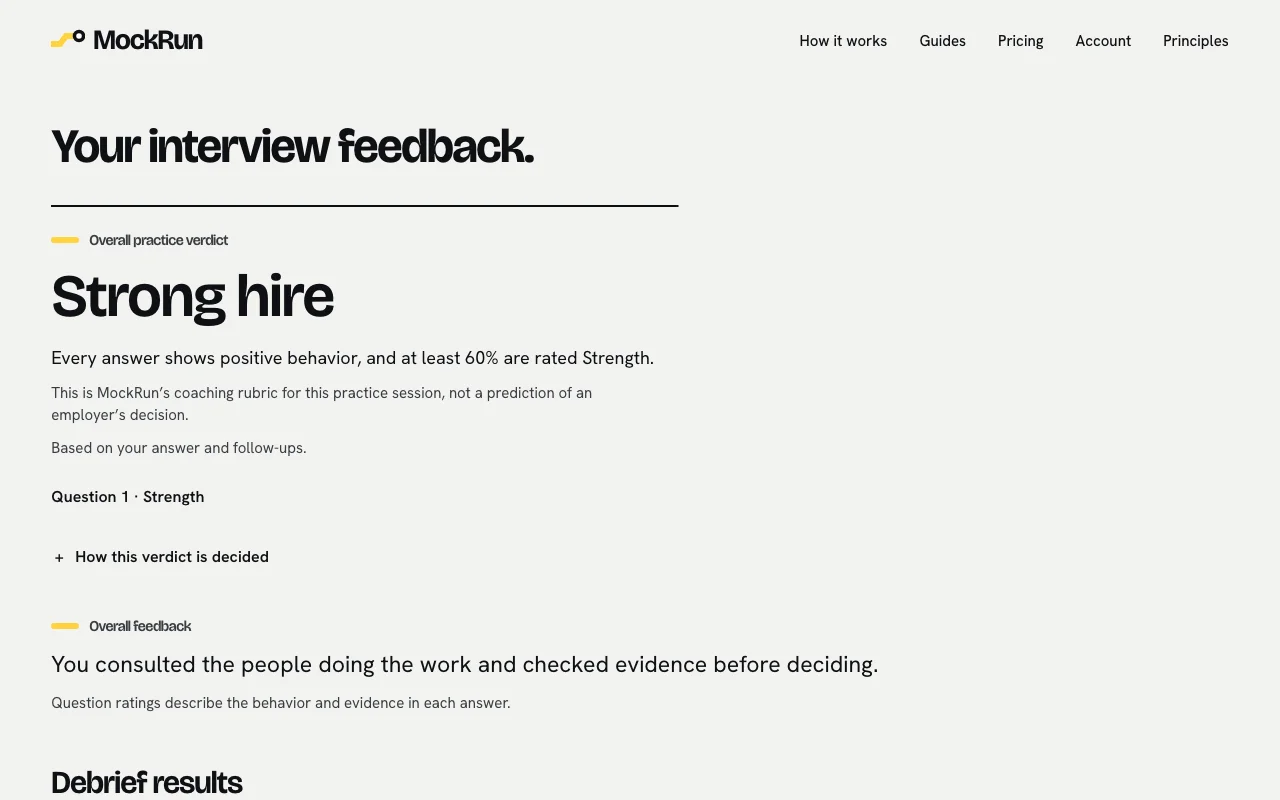
When you finish, MockRun reviews each complete answer, including follow-ups and corrections. The debrief shows overall feedback, then the evidence behind it: STARI notes, behavioral observations with the exact words that support them, and whether your example fit the question. It also names a specific detail to practice next, tied to a short excerpt from your answer.
If every planned answer is complete and has enough evidence for a verified rating, you also get a practice verdict. An answer rated Mixed, Mild concern or Concern gives No hire. If every answer is rated Strength or Mild strength, at least 60% Strength gives Strong hire, and fewer gives Hire. A missing answer, an unfinished review or too little relevant evidence to assess means no verdict. The verdict is MockRun’s coaching rubric for practice and doesn’t predict an employer’s decision.
The most common gaps show up as follow-ups first; see behavioral interview follow-up questions. When a story keeps scoring low, the fix is often a better example, covered in how to prepare behavioral interview stories.
Common questions
Does a Strong hire practice verdict mean I will pass the interview?
No. It means your answers in that practice session met MockRun’s practice rubric. A real decision depends on the interviewer, the role and the rest of your interviews, and MockRun doesn’t predict it.
Should I ask the recruiter for feedback after a real interview?
You can ask politely, but many companies share little. Right after the interview, write down the questions you were asked and what you said, so you can review your answers yourself.