How to prepare behavioral interview stories you can stand behind
Prepare behavioral interview stories by listing real situations from your recent work and keeping the ones where you made a decision that mattered at the scope of the role you want. Write down the facts you can confirm, note what you’re unsure of, then rehearse each story aloud with someone asking follow-ups. A small set of true, well-understood stories covers more questions than a stack of memorized answers.

Start from real work before the question list
It is tempting to download a list of common questions and write an answer to each. Stories built to fit a question tend to fall apart on the second follow-up, because the details were chosen for the wording.
Work the other way round. List 10 to 15 moments from the last few years where you made a call that affected other people, including projects that went badly. Amazon’s preparation advice asks for examples that show how you’ve “taken risks, succeeded, failed and grown” (Amazon’s Applied Scientist interview prep).
Then cut the list. Keep the stories where you can explain a decision in detail, name who else was involved and say what happened afterwards. A dramatic project where your part was small usually makes a weaker answer than a modest one you led.
Choose behavioral interview stories that match the role
Pick stories where the reach of your decision is close to the reach of the job you want. Read the responsibilities carefully: what would you own, who would rely on your decisions, and what outcomes would you be responsible for? Choose real examples that help explain how you approach that work.
If you have a job description, read it for the work you would actually do. In MockRun’s setup you can paste a job description or recruiter notes to see possible practice topics. Each suggestion shows the sentence from your text that prompted it, and none of them claims to know which principles an interviewer will assess.
Build a story library from facts you can check
- Give the story a short title. A few words you’ll recognize under pressure.
- Write what happened. Dates and numbers only where you can confirm them.
- Write your role separately. What you owned, apart from what the team did.
- Note your decisions and why. These become most of the spoken answer.
- Write the result. Compare what happened with your goal, using numbers you can confirm.
- Note what you’re unsure of. So you never present an estimate as a fact.
- List the questions it could answer. One story often fits two or three principles.
- Title
- Carrier label change
- What happened
- In March a carrier changed its label format with a week’s notice, and 1,200 queued orders had labels it would reject.
- My role
- Shift lead. I owned getting the queued orders out; IT owned the label software.
- Decisions
- Reprinted by promised delivery date instead of queue order. Asked IT for a permanent fix by Friday while my shift reprinted by hand.
- Result
- We cleared the 1,200 queued orders within two days. IT shipped the label fix on Friday.
- Unsure
- How many orders shipped late. I think about 40; check the report.
- Could answer
- Deliver Results, Bias for Action, or a time you handled an unexpected problem.
Written for this guide. The details are invented.
MockRun’s optional story library uses these fields. Notes stay in your browser and aren’t sent to the interviewer, and you can practice without it.
Rehearse each story out loud
Writing a story and telling it are different skills. Say each one aloud at least twice before the interview: once to get the order right, and once with someone asking follow-ups. After feedback, retell it with one change at a time. One question with follow-ups takes about 10 minutes in MockRun, so a story a day is realistic in the week before an interview.
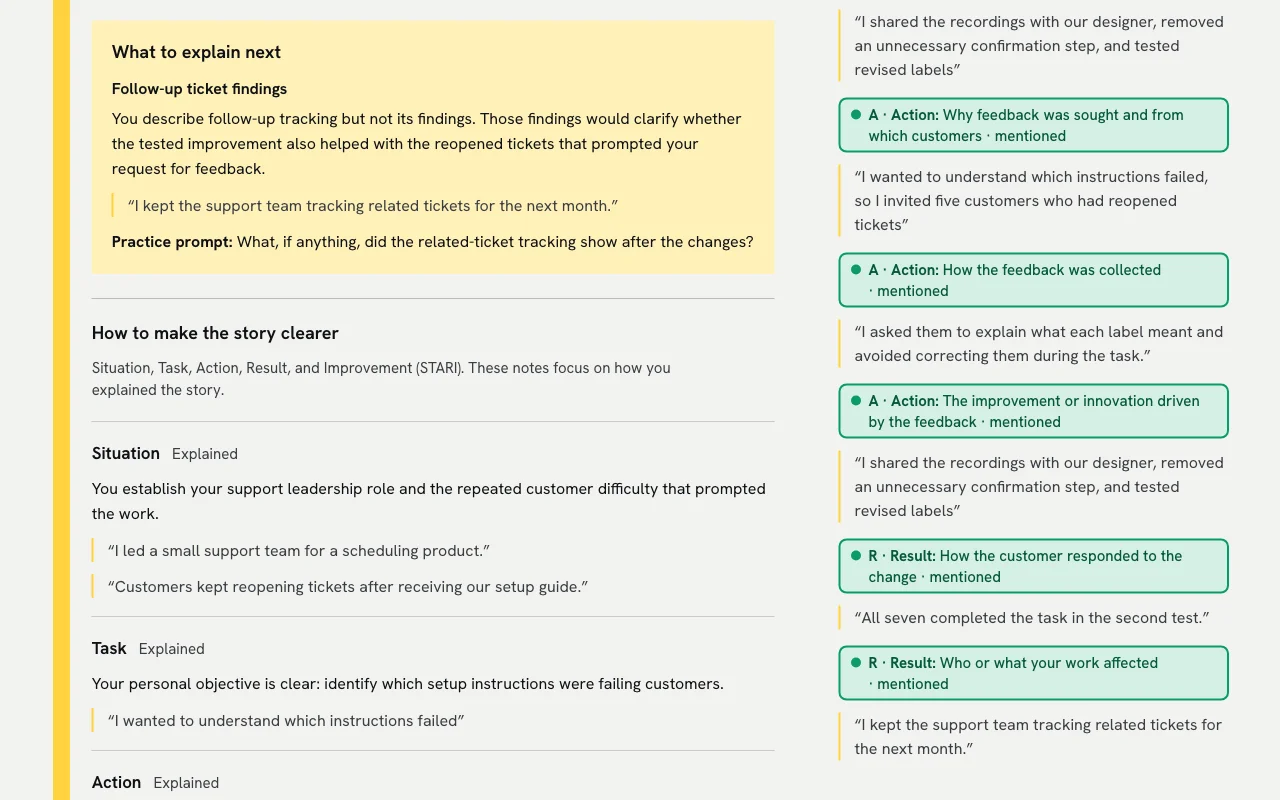
For the shape of each story, see the STAR interview method. For how much time to give it, read how long an Amazon interview story should be.
Common questions
How many stories should I prepare for a behavioral interview?
There is no fixed number. Start with a set you know well, then check for gaps across the responsibilities of the role and the Leadership Principles. One story can show several behaviors, but prepare alternatives so you can answer different questions without assuming which principles will be assigned.
Can I reuse the same story for different questions?
Yes, if it shows what each question asks. Within one interview loop, interviewers often compare notes afterwards, so use different stories with different interviewers where you can.