A disagree and commit interview example that fits the question
A strong disagree and commit answer shows two things in one story. You challenged a decision you believed was wrong, with evidence and respect, and when the decision went the other way you committed to making it work. Many answers miss because they show only the first half, or describe a disagreement the candidate won when the question asked about committing.

What the disagree and commit question is asking
Have Backbone; Disagree and Commit is one of Amazon’s Leadership Principles. Amazon’s wording asks leaders to “respectfully challenge decisions when they disagree” and says that “once a decision is determined, they commit wholly” (Amazon Leadership Principles). Other companies ask a version of it too, often as “Tell me about a time you disagreed with your manager.”
Read the exact question before you choose a story. Some questions under this principle ask about a time you pushed back, and a story where you persuaded the team can work. Others ask for a time you disagreed and then committed. Those need a decision that went against you.
Check that your example fits the question
- The disagreement was about something that mattered to the business, and you can say why.
- You raised it directly with the person who could change the decision.
- You brought evidence, such as data, a customer case or a test result.
- You can state the other side’s reasoning fairly.
- For a disagree-and-commit question, the decision went against you and you can describe what you did to make it succeed.
Leave out personality clashes and ethical lines. If someone asked you to do something wrong, refusing was the right call, and the commit half of the question doesn’t apply.
Disagree and commit example answer
- Situation
- I was the product manager for an internal sales reporting tool. Our director wanted every regional team using its new reporting workflow before quarterly planning, three weeks away.
- Task
- I owned the rollout. The report totals were correct, but two of nine pilot users needed help finding their exports. I wanted to introduce the workflow region by region to reduce disruption.
- Action
- I showed the director the pilot observations and proposed a phased rollout. She explained that planning needed every region using the same metric definitions in the same cycle. That made the common date more valuable than I had understood, though I still preferred phasing. Once she decided, I committed to the shared launch. I proposed keeping the familiar export option with the new definitions and making a short guide from the pilot users’ questions. She agreed. I worked with the analyst to compare ten reports against the approved definitions, tested the guide with those two users, and arranged office hours for launch week.
- Result
- All six regions submitted planning reports on time with the same definitions. Three users needed help with exports, and we resolved each request that day. The director kept the familiar export option for the next cycle.
- Improvement
- I had treated the date as a preference before asking what depended on it. Now I establish the business constraint first and test whether my proposal still meets it.
Written for this guide. The company, people and figures are invented.
Notice where the time goes. The disagreement takes two sentences. Most of the answer is how the candidate made the case, what they heard back and what they did once the decision was made.
Practice this question with follow-ups
Expect probes such as “What did your director say when you pushed back?” and “How did you make sure the launch went well, given your concerns?” MockRun looks at whether your example fits the exact question. If the question asks about committing and your story describes winning the argument, the interviewer can ask you to clarify or choose another example, and the debrief notes how well the example fit.
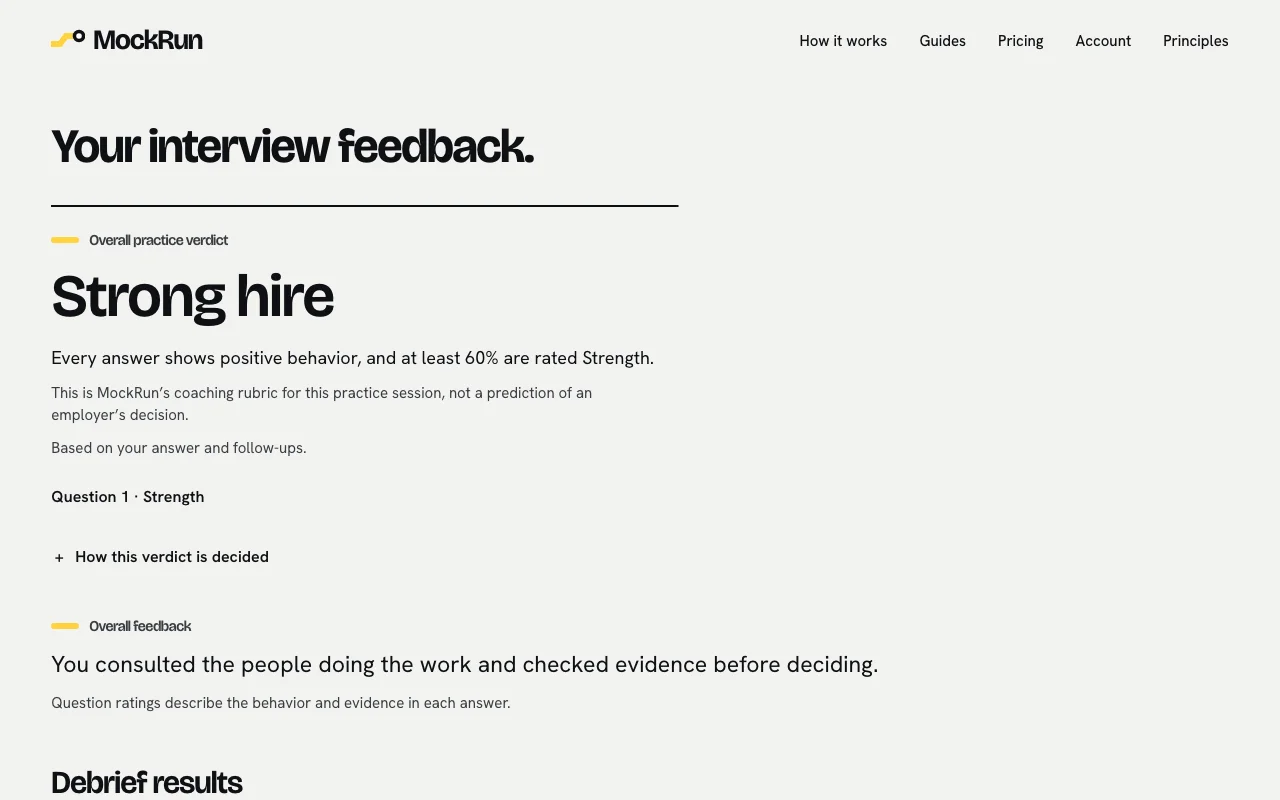
To practice this principle on its own, start a focused session on Have Backbone; Disagree and Commit. For the questions that usually come next, see behavioral interview follow-up questions.
Common questions
Can I use a disagreement with a peer instead of my manager?
Yes, unless the question names your manager. A peer disagreement works when the decision mattered and someone had the authority to settle it. Explain who decided and how you supported the outcome.
What if I was right and the decision still failed?
Describe what happened without blaming anyone. Show that you committed fully while it was the plan, then helped fix it. If you raised the issue again with new evidence, include that.