Behavioral interview follow-up questions and how to prepare for them
Behavioral interview follow-up questions ask for whatever your first answer left unclear: what you personally did, why you chose that approach, what else you considered, how you know it worked and what you would change. You can’t predict the exact wording, so prepare by finding those gaps in your own story and rehearsing the answers aloud.

Why interviewers ask follow-up questions
Your first answer is a starting point. Interviewers use follow-ups to check the details their notes depend on, such as how big the problem was, which part was yours and whether the result really happened. Amazon says its interviewers look at the what and how of your experience and the why behind your decisions (Amazon’s Applied Scientist interview prep). One uninterrupted answer rarely covers all of that.
Follow-ups also separate your work from your team’s. A story told with “we” will almost always get “Which part did you do?”
Common behavioral interview follow-up questions
- Your role: “What did you do yourself?” and “Who else was involved, and what did they own?”
- Your reasoning: “Why that approach?” and “What else did you consider?”
- The stakes: “What would have happened if nobody had acted?”
- Other people: “How did they react?” and “What did you do when they disagreed?”
- Results: “How did you measure it?” and “How did that compare with your goal?”
- Reflection: “What would you do differently?” and “Have you used that lesson since?”
A good interviewer doesn’t work through this list in order. They ask the question your answer made necessary and skip what you already covered. That is why memorized answers struggle: the second question depends on what you said in the first.
How to prepare for follow-up questions
- Tell the story once, aloud, without notes. Record it so you can read back exactly what you said.
- Mark every “we”. Next to each one, write what you personally did.
- Underline the decisions that mattered. Where you had a real alternative, note it and why you didn’t take it.
- Check the result against your goal. If they don’t match, plan to say so plainly.
- Note what you’re unsure of. If you don’t remember a figure, call it an estimate in the interview.
- Answer live follow-ups, then retell the story. Use a friend, a coach or a practice tool, and fold the answers into the next telling.
- Candidate
- Our checkout page kept timing out during sales, so we moved the inventory check to a queue and the errors went away.
- Interviewer
- You said the errors went away. How did you check that?
- Candidate
- I compared timeouts for the two sales before and after the change. They went from about 4% of checkouts to under half a percent. I also asked support whether complaints about failed payments had dropped, and they had.
- Interviewer
- What did you give up by using a queue?
Written for this guide. The first probe checks the outcome and the second asks about the trade-off behind the choice. Rehearse both kinds.
Practice behavioral interview follow-ups with MockRun
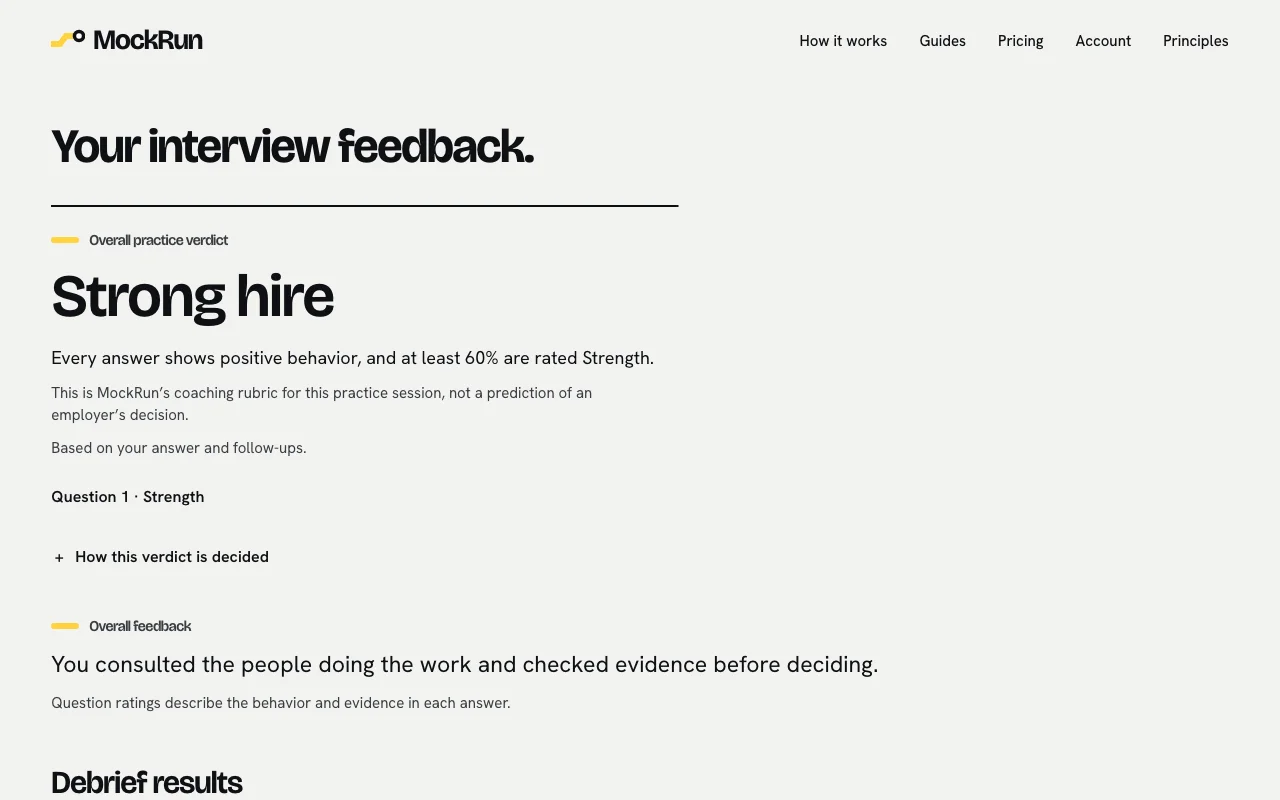
MockRun reads your whole story before it chooses each follow-up, so the probes focus on details that are still missing. It asks one follow-up at a time, about the story you just told, and it can ask its own question when something you said needs explaining. If your story seems to describe a different situation from the one asked about, it can ask you to clarify first.
You answer out loud by default, which is closer to a real interview, or you can type. Your follow-up answers are saved with the initial answer in the debrief, so you can see what each probe added.
Follow-ups are easier when the structure is solid; start with the STAR interview method. To see what feedback on those answers should include, read what useful behavioral interview feedback looks like.
Common questions
How many follow-up questions should I expect for one answer?
It depends on how complete your first answer is. A detailed story may get one or two follow-ups and a vague one can get many more. In MockRun, probes focus on what your story left out, so a complete answer tends to get fewer of them.
What if I don’t remember the detail a follow-up asks for?
Say so and give what you do know, such as an estimate labeled as an estimate or how you would find out. Inventing a precise figure is riskier, because the next follow-up often asks how you measured it.