How long should an Amazon interview story be?
Day One Careers, run by a former Amazon Bar Raiser, recommends an opening story of about 5 to 9 minutes for an Amazon behavioral question. More complex stories need room to explain the reasoning, with time left for follow-ups. This is coaching guidance, not an Amazon time limit. Follow the timing and direction your interviewer gives you.

Why two minutes may not be enough for an Amazon story
Short answers can suit a screening call that covers many questions. A behavioral interview may give you more room to explain one experience, but its format and the interviewer’s direction still matter.
Amazon’s preparation pages say each interviewer typically asks two or three behavioral questions and focuses on what you did, how you did it and why you made your decisions (Amazon’s Applied Scientist interview prep). That can leave room for depth, including follow-ups about your reasoning. The Day One Careers breakdown of Amazon STAR stories suggests about 5 to 9 minutes for an opening answer. Use that as a rehearsal target and adapt to the actual interview.
Complexity changes how much context a story needs. A decision involving several competing constraints may need more explanation than a straightforward fix. Name those constraints, explain how you weighed them and show what you chose. Cutting the story to 90 seconds can remove the reasoning the interviewer came to hear.
How to divide a 5–9 minute behavioral answer
- Situation and task, about a minute: enough for the stakes and your goal to be clear.
- Action, most of the time: your decisions, the options you weighed and how you worked with people.
- Result, under a minute: what changed compared with the goal, with numbers if you have them.
- Improvement, under a minute: what you changed afterwards or would change next time.
These are rough proportions. The point is that the action should fill most of the answer, because that is where the interviewer learns how you work.
Signs your interview story is too long or too short
A story that runs long usually has too much situation. If you are three minutes in and haven’t said “I decided”, the interviewer is still waiting for the answer. Retelling the same step twice and describing team activity you didn’t lead are the other common causes.
A story that runs short usually summarizes the action. “I aligned the stakeholders and we shipped” takes five seconds to say and invites five follow-ups. Expand each verb: which stakeholder, what they objected to, and what you offered.
- Candidate
- Our onboarding emails had low open rates, so I redesigned the sequence and opens went up 30%.
- Interviewer
- What did you look at before you redesigned it?
- Candidate
- I grouped the 14 emails by when people opened them. Almost nobody opened anything after day three, but most new users opened the first two. I could rewrite all 14, which would take a month and keep the timing problem, or move the setup steps into the first two emails and cut the rest. I cut the sequence to five and tested it against the old one for two weeks.
Written for this guide. The longer reply adds under a minute and answers the questions the short version raised.
Practice the timing before the interview
Length is hard to judge in your head. Tell the story aloud with a timer once, then again after trimming the situation.
In MockRun, each question is planned for about 10 minutes including follow-ups. Aim for 5 to 9 minutes on your story. Around the 10-minute mark, the interviewer waits for you to finish your thought, invites one final detail, then moves on. You can also finish early and still get feedback. When pacing is worth mentioning, the debrief comments on it separately from the story rating and quotes the words where you repeated yourself or drifted. MockRun does not measure how long you spoke, so pacing notes come from your words, not from elapsed time.
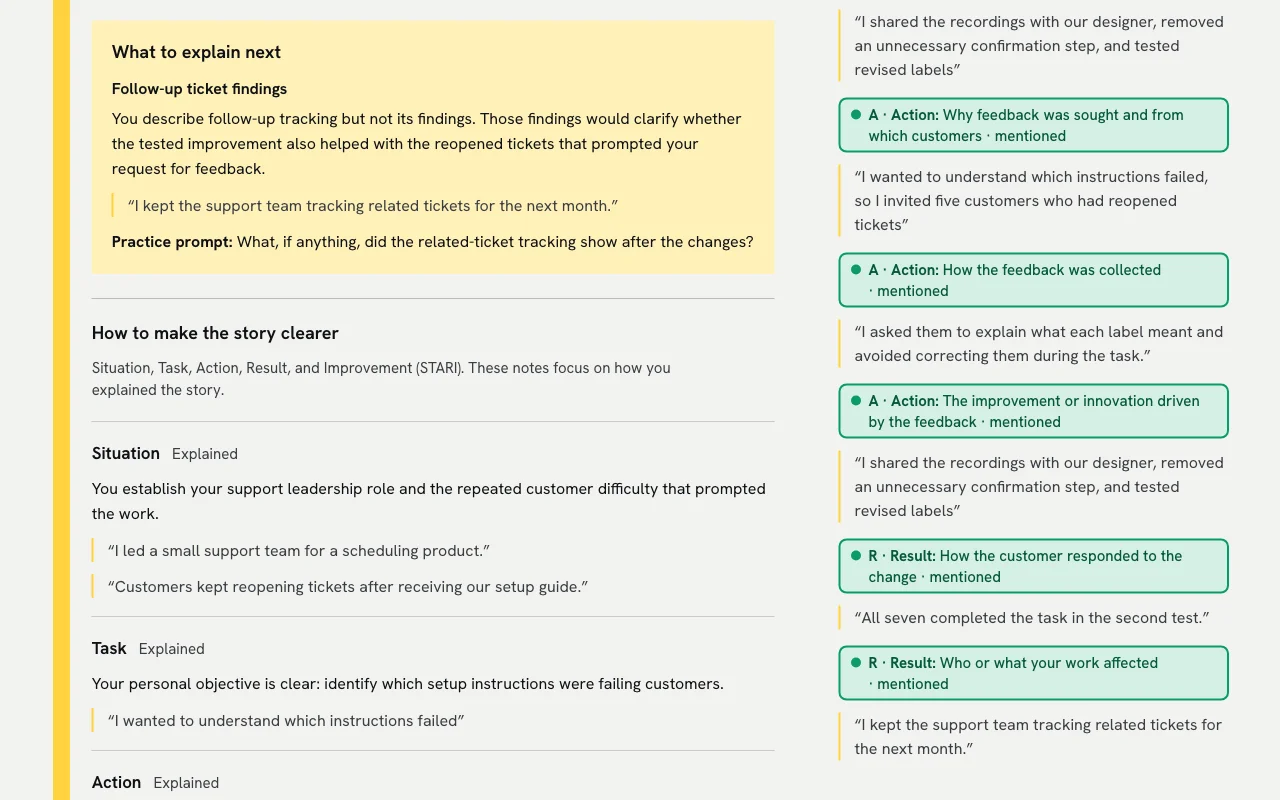
For the structure inside those minutes, see the STAR interview method. To pick which stories deserve the time, read how to prepare behavioral interview stories.
Common questions
Should I check whether the interviewer wants more detail?
Follow any timing or direction the interviewer gives you. If the context is complicated, one quick check after the situation is reasonable. Avoid asking permission repeatedly, because it breaks the story into pieces.
Is a two-minute STAR answer ever right?
Yes, for screening calls, panels that cover many questions quickly, and simple stories. When each interviewer asks only a few questions in depth, two minutes rarely leaves room for your reasoning.